~ Press Reviews ~
Company Glance Magazine
In This Article, You’ll Discover:
- The true story of a young boy in an 1850s photo studio.
- The highly dangerous chemicals used in early darkrooms.
- Hidden facts about child labor in New York.
- A fierce media battle with showman P.T. Barnum.
- How early photo methods changed everyday life.
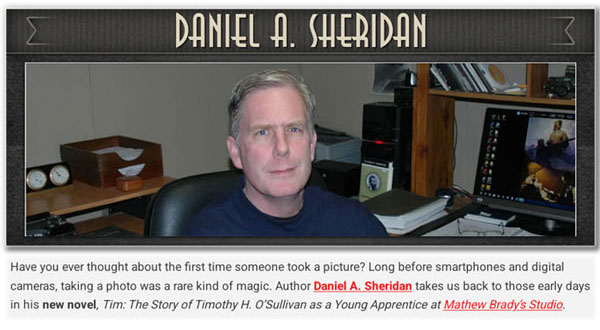
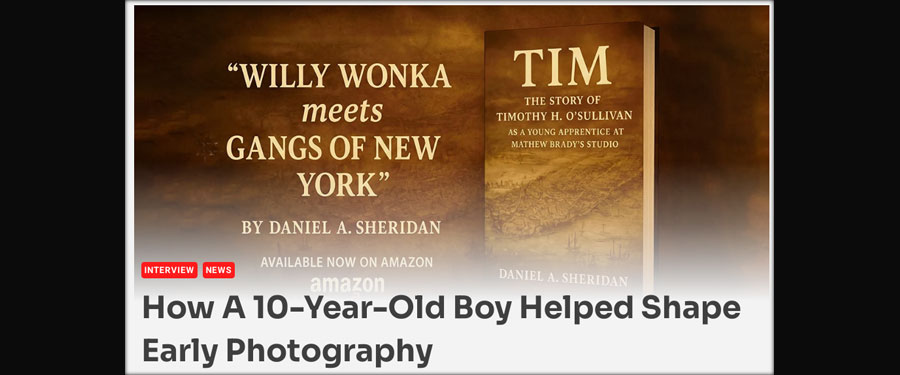
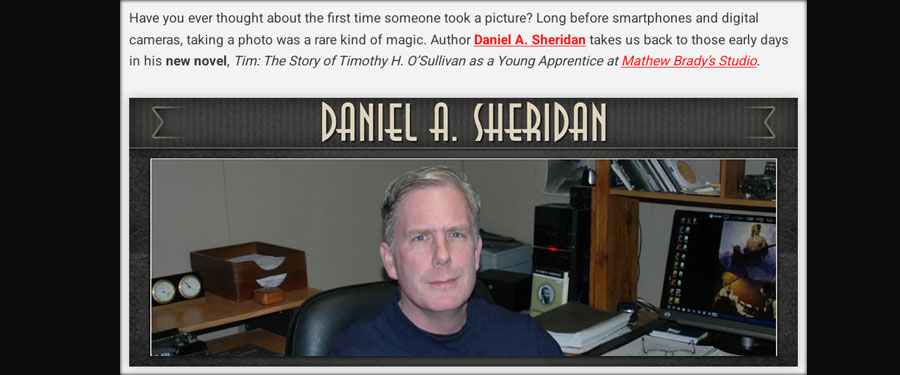
Have you ever thought about the first time someone took a picture? Long before smartphones and digital cameras, taking a photo was a rare kind of magic. Author Daniel A. Sheridan takes us back to those early days in his new novel, Tim: The Story of Timothy H. O’Sullivan as a Young Apprentice at Mathew Brady’s Studio.
A Spark In The Darkroom
Daniel knows a lot about the magic of making pictures. He grew up developing black and white film with his dad in their basement. He remembers carefully mixing chemical potions from yellow bags beneath the eerie glow of a red safe light. This incredible hands-on experience made him the perfect person to write about the birth of American photography.
“In the darkroom, after focusing the negative, my Dad lifted the lid to the lead-lined box to pull out a glossy sheet of photographic paper. … I watched the white glossy paper magically transform before my eyes in the ripple of developer waves into a photograph.”
The Danger Of The Dark Art
Back then, making a picture felt a lot like magic. The term Dark Art originally comes from ancient alchemy. Long ago, alchemists tried to use magic to turn ordinary metal into gold. Over time, these early dreamers became our modern chemists. They discovered the exact chemicals needed to develop a photograph and lock it in place with a fixer.
However, practicing this Dark Art was incredibly dangerous work. Early photographers used harsh substances to make images appear on metal plates. Workers had to deal with toxic mercury vapors just to create a single photo. Daniel uses his background to show the brave people who risked their health for this new technology.
“You see Tiny Tim, Mr. Lawrence has fallen victim to the mercury vapors from his endless hours toiling away in close proximity to the fuming hood. He suffers from the most acute pain and is unable to walk. His legs and arms have swollen to twice their ordinary size.”
Uncovering Hidden History
Most people know Timothy H. O’Sullivan for his famous, haunting photos of the Civil War. Many historians think he started his photo career at age 18. But Daniel dug deep into his historical research and found clues that point to a much younger start. While it is hard for a modern audience to imagine, child labor was very common back then.
“In a letter of recommendation, Brady states that he had known Tim ‘from boyhood’ which indicates a younger age than 18 or 16. He did not say young man or youth, he said ‘boyhood.’ In addition to this, I note that Brady’s own nephew, Levin Handy, began work at his uncle’s studio at the age of 12 in 1865.”
A Gift For Everyday People
Photography completely changed the world. Before the camera, only wealthy royalty could afford to have their portraits painted.
“In the days before photography, only a prince or a priest could afford to have their portrait painted. Now all of us can have a likeness of ourselves, of our mother and father, of our children and grandchildren.”
Showmen And The Media Battle
The book also shows a fun rivalry that feels very modern. Mathew Brady was a highly respected photographer who treated his work as high art. Directly across from his gallery stood P.T. Barnum’s famous American Museum. This was a place filled with oddities, hoaxes, and loud spectacles designed to draw a crowd.
When Barnum refuses to let Brady photograph the famous singer Jenny Lind, a fierce competition begins. This was an early battle for media attention. Barnum completely understood the hungry appetite of the press and knew exactly how to feed the beast. He planted fake stories and used massive street posters to manipulate the news so people would buy tickets to his shows.
It is fascinating to see how people fought over celebrities and news coverage in 1850. It reminds us heavily of how the internet and digital media work today. Even back then, knowing how to capture a crowd’s attention was just as important as the technology itself.
A Window Into Early Tech
By focusing on Tim’s childhood, the book gives us a fresh look at a famous historical figure. It explores the fascinating technical jump from early daguerreotypes to more advanced photo methods through the eager, observant eyes of a child.
This dedication to the craft highlights the unseen sacrifices behind early portraiture. Because of these early pioneers, regular citizens could finally keep visual memories of their families.
If you love history, compelling rivalries, or reading about the wild days of early tech, this story is a must-read. You can secure your copy of Tim: The Story of Timothy H. O’Sullivan today and step right into the bustling, brilliant streets of 1850s New York. ❏
Click here to read full Press Review on CompanyGlance.com
Rich Man Magazine
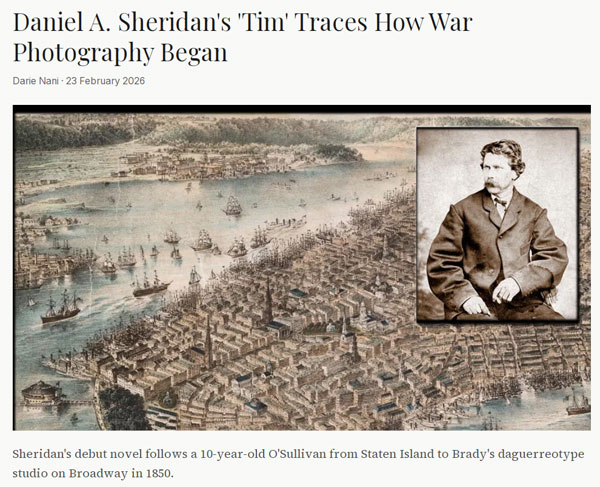
Tim: The Story of Timothy H. O'Sullivan as a Young Apprentice at Mathew Brady's Studio
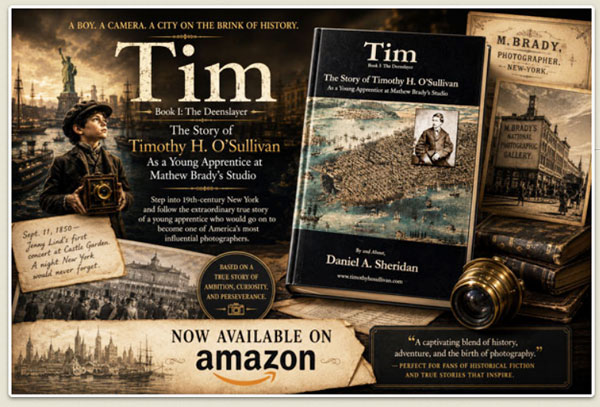
Set in 1850s New York, Tim fictionalises the early life of Civil War photographer Timothy H. O'Sullivan as a 10-year-old apprentice at Mathew Brady's daguerreotype studio on Broadway, opposite P.T. Barnum's American Museum. Written by a former photojournalist and darkroom technician, the novel blends historical detail with the daily craft of early American photography.
Daniel A. Sheridan's debut novel Tim follows 10-year-old Timothy H. O'Sullivan from Staten Island to Mathew Brady's daguerreotype studio on Broadway. O'Sullivan would go on to produce some of the most reproduced battlefield images in American history, including A Harvest of Death at Gettysburg. But his early years are almost entirely undocumented. No diaries, no letters, no first-hand accounts from his childhood survive. Sheridan, a former photojournalist and darkroom technician, fills that gap with a debut novel grounded in genuine photographic expertise.
Brady, Barnum and the Broadway Arms Race
The novel opens on 11 September 1850, the evening Jenny Lind made her American debut at Castle Garden. Young Tim crosses New York harbour by ferry and rides an omnibus up Broadway to Brady's gallery, which sat directly opposite P.T. Barnum's American Museum. Sheridan uses the proximity to frame a contest that defined mid-century Manhattan: Brady pursued photography as portraiture and art, Barnum sold spectacle to the masses, and the public was still deciding what this new medium was actually for.
The historical grounding is precise. Lind's debut, Tim's route from Staten Island and the geography of lower Broadway all map to verifiable records and period maps. This is not a novel that borrows an era's aesthetic and fills in the gaps with atmosphere. Sheridan has done the archival work, and the specificity shows in every scene.
O'Sullivan's Lost Childhood
The biographical record for O'Sullivan before the Civil War is thin. Biographers place his birth in Ireland around 1840, to Jeremiah and Ann O'Sullivan. The family settled on Staten Island at some point during his infancy. Records confirm he worked at Brady's studio as a young man. Beyond those facts, the trail goes cold.
Tim occupies that silence with informed fiction, writing the daily mechanics of a working daguerreotype studio: the polished silver-coated plates, the mercury vapour developing process, exposures timed by instinct rather than meter. These are not decorative passages. Sheridan writes them as someone who has stood in darkrooms, mixed chemicals and processed images by hand. The result reads more like archival reconstruction than invention.
Photography as Narrative, Not Backdrop
This is what distinguishes Tim from other historical fiction set around early American photography. Most novels treat the technical work as set dressing. Sheridan makes it structural: the chemistry creates tension in the plot, the studio's routines shape Tim's character and the gradual evolution from daguerreotype to newer photographic processes runs parallel to the boy's development as an apprentice.
O'Sullivan left Brady's studio to photograph Civil War battlefields independently, producing images that changed how Americans understood armed conflict. He later documented the Western frontier on government survey expeditions, working from a converted ambulance wagon that served as a mobile darkroom. Tim captures the training and instincts that made that career possible, written by an author with the technical credentials to get the details right.
Further Context
What are some facts about Timothy O'Sullivan?
O'Sullivan was born in Ireland around 1840 and emigrated to the United States as a young child. His family settled on Staten Island, New York. He began working in Mathew Brady's photography studio as a teenager, learning the daguerreotype process before the Civil War. During the war, he produced iconic battlefield images for both Brady and Alexander Gardner. He later joined government survey expeditions to the American West, capturing landscapes that remain central to American photographic history.
Who is considered the most famous Civil War photographer?
Mathew Brady is the most widely known figure, though he operated more as a publisher and organiser than a field photographer. His associates (Alexander Gardner, George Barnard and Timothy O'Sullivan) did the majority of on-location work. Brady's contribution was systemic: he built the infrastructure for photographic war documentation, secured access to battlefields and ensured the images reached the public. O'Sullivan's work, particularly at Gettysburg, remains among the most reproduced Civil War imagery.
What camera equipment did Timothy O'Sullivan use?
O'Sullivan worked with large format cameras using glass plate negatives, the standard equipment of the 1860s. These cameras required lengthy exposure times, on-site chemical preparation and careful transport of fragile plates. In the field, he operated from a converted ambulance wagon that functioned as a mobile darkroom. Civil War photography was as much about logistics and chemistry as it was about composition and timing.
ABOUT
Daniel A. Sheridan
 Daniel A. Sheridan is a New York University graduate whose professional career spans photojournalism, darkroom work and editorial roles. His debut novel Tim: The Story of Timothy H. O'Sullivan as a Young Apprentice at Mathew Brady's Studio draws directly on his technical expertise in early photographic processes and his deep knowledge of American photographic history. The novel was released on 20 February 2026 and is available on Amazon.
Click Here to visit: Rich Man Magazine
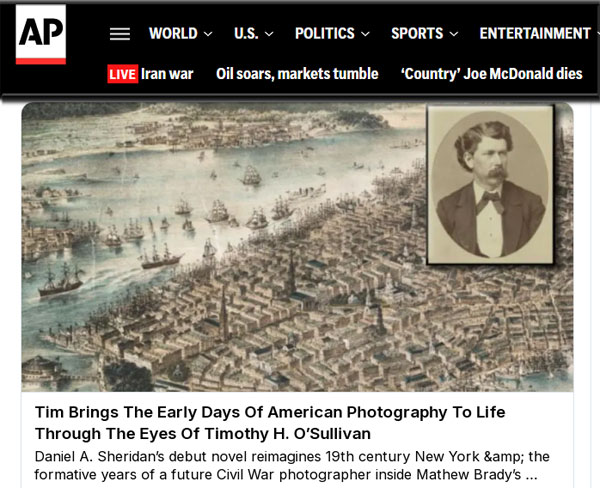
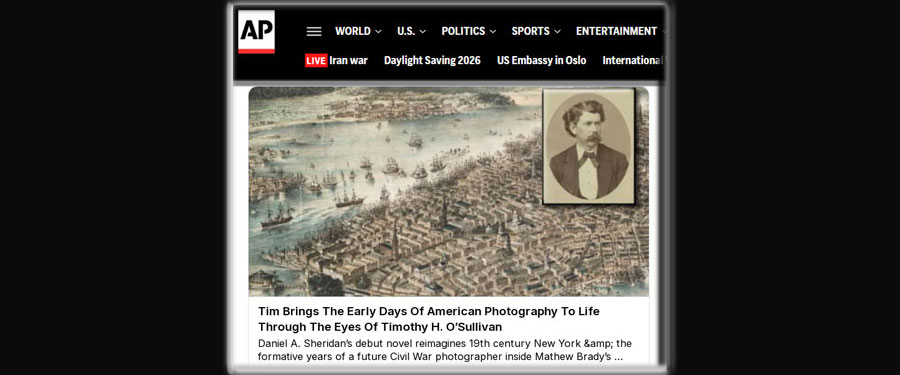
Tim Brings The Early Days Of American Photography To Life Through The Eyes Of Timothy H. O’Sullivan
Daniel A. Sheridan’s debut novel reimagines 19th century New York & the formative years of a future Civil War photographer inside Mathew Brady’s famous studio.
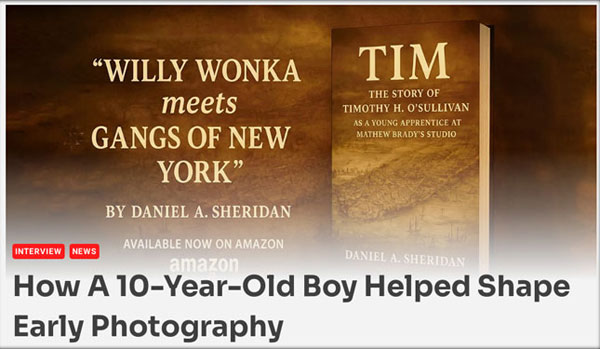
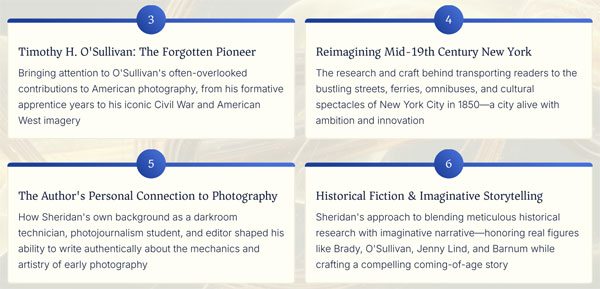
NEW YORK CITY, NY, UNITED STATES / AssociatedPress.com / -- In Tim: The Story of Timothy H. O’Sullivan as a Young Apprentice at Mathew Brady’s Studio, author Daniel A. Sheridan transports readers to the bustling streets of New York City in 1850, where art, ambition, and innovation collide. Inspired by the early life of famed Civil War photographer Timothy H. O’Sullivan, the novel blends historical detail with imaginative storytelling to illuminate the birth of American photography.
The story opens on September 11, 1850, the night of Jenny Lind’s celebrated debut at Castle Garden. Ten year old Tim, a boy from Staten Island, is sent to apprentice at the daguerreotype studio of Mathew Brady, one of the most influential photographers of the era. Crossing the harbor by ferry and traveling up Broadway by omnibus, Tim steps into a city alive with spectacle and possibility.
Directly across from Brady’s gallery stands P.T. Barnum’s American Museum, filled with relics, curiosities, and the spirit of showmanship that defined mid nineteenth century entertainment. As Tim explores this vibrant world, readers are introduced not only to the mechanics of early photography but also to the cultural energy that shaped it. The novel captures the tension between art and commerce, innovation and rivalry, as photographers compete for access to the era’s most sought after celebrity, Jenny Lind.
When Barnum refuses Brady permission to photograph the Swedish Nightingale, the challenge becomes both personal and professional. With the keen eye and growing skill of his young apprentice, Brady pursues creative solutions. Through their dynamic relationship, Sheridan skillfully illustrates the technical evolution from daguerreotype to more advanced photographic processes, framing it as a creative battle between competing methods and national influences.
Sheridan brings authenticity to the narrative through his own background in photojournalism and the history of photography. A graduate of New York University with hands on experience as a darkroom technician and editor, he weaves historical research with artistic insight, honoring O’Sullivan’s later achievements while focusing on his formative years.
The book is now available on Amazon— secure your copy here: Amazon.com
Author Media Kit
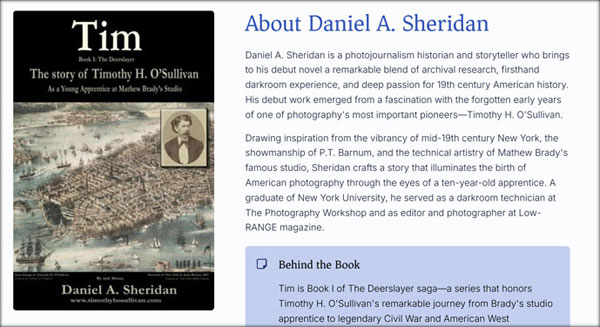
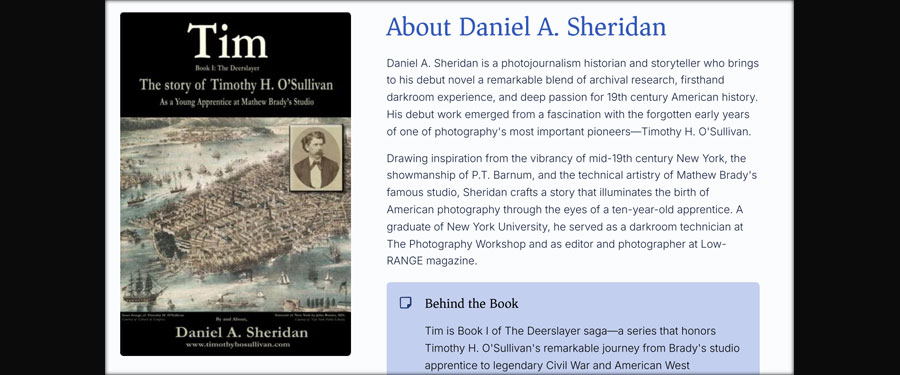
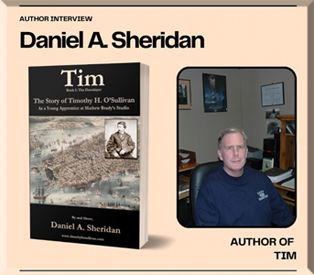
Daniel A. Sheridan is a photojournalism historian and storyteller who brings to his debut novel a remarkable blend of archival research, firsthand darkroom experience, and a deep passion for 19th century history. His debut work emerged from a fascination with the forgotten early years of one of photography's most important pioneers - Timothy H. O'Sullivan.
Drawing inspirationg from the vibrancy of mid-19th century New York, the showmanship of P.T. Barnum, and the technical artistry of Mathew Brady's famous studio, Sheridan crafts a story that illuminates the birth of American photography through the eyes of ten-year-old apprentice. A graduate of New York University, he served as a darkroom technician at The Photography Workshop and as editor and photographer at Low-RANGE Magazine.
Tim - Book I - The Deerslayer saga — a series that honors Timothy H. O'Sullivan's remarkable journey from Brady's studio apprentice to legendary Civil War and American West photographer.

Click here to download Author Media Kit.
Goodreads Reviews: ★★★★★
"Sheridan writes about photography the way poets write about love."
~ John Peter, Goodreads Reviewer
Regina Kate
There’s something enchanting about reading a book that feels painted rather than written. Tim is that kind of story. Every scene glows with light and shadow, like one of the daguerreotypes Sheridan describes. I could practically see the silver plates reflecting the city’s fog and faces. What stood out most to me was the tenderness with which Sheridan writes about mentorship and creativity. Brady is both genius and tyrant a man obsessed with capturing immortality. And Tim? He’s the perfect lens through which we see the world’s transformation. Beautifully told, meticulously detailed, and full of heart. I’ll be thinking about this one for a long time.
Jeffrey Shawn
I think what Sheridan accomplishes here is beyond storytelling, it’s preservation. He’s taken a largely forgotten figure, Timothy O’Sullivan, and given him a voice, a childhood, and a place in our imagination. The research is clear, but it’s never dry. What you feel instead is reverence for art, for craftsmanship, for those who dared to experiment before there were manuals or safety nets. The friendship-mentorship between Brady and Tim reminded me of relationships in my own life: stern guidance mixed with deep, unspoken respect. Every time Tim learned something new about light or time, I felt that same spark of wonder. By the end, I wasn’t just reading about photography I was seeing how passion and persistence shape who we become. A stunning, soulful work.
Margaret
The writing is so rich that I had to slow down just to savor certain passages. Sheridan’s New York is colorful and alive, equal parts wonder and danger. Absolutely engrossing.
Ava Bradford
Every word feels etched in silver. Sheridan’s writing is that precise, that luminous. Tim is one of those novels that feels slow in the best possible way it makes you linger, observe, notice light on faces and dust in the air. It reminded me why I fell in love with both photography and storytelling in the first place.
Sabine Traeder
What amazed me most about this book is its balance it’s sweeping in historical scope yet intimate in emotion. You see photography being born, but also a young boy learning about responsibility, creativity, and himself. Sheridan manages to make history feel deeply personal. That’s a rare gift.
Frank
Daniel A. Sheridan has crafted something far more ambitious than a simple historical novel. Tim is a genuine reconstruction of a moment in American history that we rarely see explored the messy, experimental, almost mystical birth of photography as an art form. Sheridan’s attention to detail is staggering. Whether he’s describing the texture of a daguerreotype plate or the feel of walking through pre–Civil War New York, every sensory cue feels authentic. But the true strength of the novel lies in Tim himself. His innocence, curiosity, and occasional fear give the book emotional grounding. Through Tim, we witness the awe of capturing an image for the first time an act that feels simultaneously scientific and magical. Sheridan’s portrayal of Mathew Brady adds another layer of depth, offering a portrait of a complicated artist whose genius borders on obsession. A stellar, meticulously researched, emotionally resonant story.
Elijah William
It’s astonishing that this is Sheridan’s first novel. The confidence, the rhythm, the emotional intelligence it feels like the work of someone who’s been writing for decades. Tim isn’t just a debut; it’s an arrival. It’s the kind of story that honors both history and the human heart.
John Peter
Light that’s what this book is really about. How we see it, how we capture it, how it changes us. Sheridan writes about photography the way poets write about love. Each page feels illuminated by admiration for those who first learned to trap light on glass. Absolutely beautiful.
Roselia
This story reminded me why I love creative people — they see the world differently. Sheridan’s writing has that same visionary quality. You can feel his reverence for art, his empathy for Tim, and his fascination with how new technology changes us. It’s rare to find a book that feels both historical and modern in spirit. Tim is about invention, yes, but also about courage, the courage to imagine a world that doesn’t exist yet. Reading this felt like standing in front of an old photograph and realizing the people inside it once breathed, dreamed, and fought for beauty. That’s powerful storytelling.
 Alfred
From the first page, it’s clear Sheridan knows what he’s writing about. His background as a photojournalist gives the story incredible depth. I loved how the book showed the clash between old and new ideas daguerreotype versus modern photography through the lens of a young boy’s ambition. Beautifully told.
Click here to read Tim book reviews on GoodReads.com


 Click here